Sunday, October 31, 2010

Deseret International Charities Completes Five Clean-water Stations for Bayanzurkh District


Deseret International Charities built and donated five clean-water stations to the people of Bayanzurkh District.  The stations were built in areas where people have had to haul water long distances, usually by hand, over difficult terrain—steep hills, mucky swamps, slippery slopes, etc. Having a clean-water station in their neighborhood is a huge improvement over hauling water long distances over this type of terrain.

Richard wrote:  Deseret International Charities' construction of five clean-water stations for Bayanzurkh District in Ulaanabaatar is complete.  We had the opening ceremonies and all water stations are in operation.  Both contractors were great and had several crews working on the water stations simultaneously.  Construction on the first station began August 20th and the last station was completed October 9th.

Opening ceremonies for the three stations in the 2nd Khoroo were held October 12th and the ceremonies for the two stations in the 23rd Khoroo were held on October 16th.  We had a good turn out at all ceremonies with excellent media coverage as well.

As part of the project, Khoroo governors will soon provide sanitation training in the schools for children and parents.

The beneficiaries are grateful and excited to have clean water available in their neighborhoods.


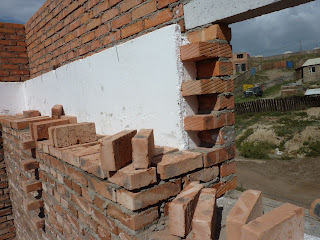
The walls of the stations are very thick and well insulated to keep the water from freezing with temperatures reaching as low as -30 to -50 F.  Each station is equipped with a small stove that burns wood and coal.  Each station has a room (office) for the operator who sells the water and runs the station, a room for fuel storage, and a large room to house the 8,000-liter water storage tank.  The tanks are made of steel and are imported from China. They will be filled 2-3 times/week as needed.  Above is a picture of one of the tanks, plus a sample of the thickness of the walls.


The exterior walls include an outside layer of brick, a 4-inch layer of Styrofoam, and another 3 rows of brick.  The inside of the walls are then coated with plaster and are painted.  The walls end up being about 20+ inches thick.  Each station also has a ramp for the water truck to pull up on so it can fill the tank with water.


The buildings are 6 meters square, not counting the ramp.  They are much larger than the well houses DIC built, because they house a much larger water tank.    The windows are high quality double-paned glass.  They are quite attractive and almost look like small churches.   Sometimes the operators fix them up to look really homey inside.


Monday, October 25, 2010

Deseret International Charities' Wheelchair Donations

October 11, 2010 – Wheelchair donated to Buyannemekh
Buyannemekh was a tall, handsome, college student attending the National University of Mongolia and studying Bio-technology.
In 2006, before his graduation, Buyannemekh was beaten up. His injuries left him paralyzed from the waist down and with limited use of his hands. He wasn’t able to finish his course work and, as a result, he missed his college graduation. He went to China for two or three months of treatment, but since then, he has lain at home in his bed. Buyannemekh’s younger brother, Altanbaagan, who is about a foot shorter than Buyannemekh and Buyannemekh’s mother care for his daily needs. Once in awhile his family takes him out of their home for a ride in a car, but usually he just lies on his back in his bed.
One of his college classmates, Batchimeg who is a returned missionary, delivered his request for a wheelchair to DIC. Batchimeg went with us when we delivered the wheelchair. She was saddened to see his condition but happy to see him receive a wheelchair.
Buyannemekh and his mother expressed their sincere appreciation for the wheelchair. We hope it will increase his mobility and help him enjoy life more.

On October 22nd, Damdin Suren, who is a retired church member, accompanied us the small apartment of his life-long friend, Batmunkh who is sixty years old. Damdin Suren and Batmunkh worked together for many years on heavy construction.  Batmunkh lifted and carried many heavy loads on construction sites. He has had back pain for a long time, but five years ago, he had a serious back injury. He could still walk, but it was very painful.

On the advice of his doctor, Batmunkh traveled to China for an operation. Unfortunately, the operation left him paralyzed from the waist down.

Batmunkh can sit in a chair alone and wheel a wheelchair, but someone has to assist him to sit up and move into a chair. He has a huge bedsore, and because of it, he can’t even take a shower. He said he doesn’t like laying down all the time. Sometimes he borrows his friend’s wheelchair and gets up and makes cookies. He has a secret recipe that no one else in Mongolia has. Sometimes he receives orders from Americans and Japanese people for his special-recipe cookies.
He was delighted to receive the wheelchair. He has big plans to build a bakery next to his apartment building and was thrilled because now he will be able to sit up and bake in his bakery. He said the wheelchair would be just perfect! He said he hopes we will still be in Mongolia when he opens his new bakery in April because he wants to invite us to its opening.

October 24, 2010
We delivered three wheel chairs to individuals.


The first was to the 84-year old father of Munktsetseg who is a member of Khailaast Branch. Purev Chogdov was really pleased with his new wheelchair and as soon as he was helped into the wheelchair, he took off wheeling around the two-room home.

He said he is really happy to receive the wheelchair because he gets really tired of lying in bed all the time.


The next delivery was to a woman who is an active member of the Church named Dorjpalam Ulzii. She was born in 1944 and is 66 years old.  She is planning on going to the temple as soon as possible, however, because walking is so painful for her, she has been unable to even attend church for a long time. As we drove over steep, uneven, rocky, ger-district “roads” to her home, we were grateful that we were in a four-wheel drive vehicle. The Khailaast Branch President, Nassanbold, accompanied us. When we asked him how Dorjpalam traveled these roads when she came to church, he replied, “Walking very slowly.” As we arrived at her home, her son told us that she had gone to the hospital, so we decided that as long as we had time and the wheelchair with us, we would deliver it to her there. It was a long way across town and we would have never found it alone, but thanks to
President Nassanbold and Brother Otgonbayar, who went with us because he said he wanted to do service, we finally found the building nestled deep in a ger district. As we opened the door to her room, we found Dorjpalam’s angelic-looking face greeting us. She was delighted. Receiving a wheelchair was a dream come true for her.

And finally, we took a wheelchair to Baatarnyam who is about 55 years old.   He has had a couple of strokes.  About three months ago, he had a tragic accident.   He was collecting plastic bottles around the railroad tracks when he became dizzy and passed out on the train tracks.  A train came along and cut off one of his legs just below the knee.  

He and his wife have been investigating the Church, so the missionaries brought us a request to give him a wheelchair.  Baatarnyam and his wife didn’t know we were coming and when we arrived, the door to Baatarnyam’s fence was locked. Elder Bashka, Elder Wilson and Richard banged and banged on the gate. We thought Baatarnyam must be home because the gate was locked from the inside, but in spite of a band of loud banging, no one came to answer the door. Just as we were about give up, we had a tender mercy. Three young boys came bounding down the steep hill. 

The Elders asked the boys if they knew the people we wanted to see. They said they did and before we knew it, all three, like agile monkeys, scaled the tall fence, dropped down on the other side and ran to the house. After rousing Baatarnyam’s wife, they came running with her back to the door to let us in.


Baatarnyam’s wife and Baatarnyam were really surprised. She cried and cried. At first, Baatarnyam was speechless, but as he was helped into his new wheelchair, he uttered bursts of gratitude and profuse handshaking. As we left, we received one final hug from Baatarnyam’s teary wife, then we waved good-by.

Sunday, September 26, 2010

Deseret International Charities Received a Shipment of 500 Wheelchairs


This week, DIC received a shipment of 500 wheelchairs from China that DIC will be donating to the needy people of Mongolia. The wheelchairs arrived at the train station in Ulaanbaatar on Sunday and by Thursday, they were safely in storage.


It took
a lot of time and work to get them through Customs and into storage, but we had many helping hands who willingly worked to get the work done. Two groups of Helping Hands unloaded two containers of wheelchairs at two separate locations. Each group was treated to a pizza party after the unloadings.

Tuesday, September 7, 2010

Deseret International Charities Donates Vision Equipment and Training to Mongolia


The Vision Project occupied most of our time the last two weeks. The week of August 22nd was spent preparing for the project and the week of August 29th was spent carrying out the project. We have been planning this project for months with Dr. Roger Harrie and his wife Bev from Utah, USA. Dr. Harrie is a widely-renown author and ophthalmologist with the Moran Eye Institute in Salt Lake City. He and his wife donated their time to prepare for, travel to, and present this training to about 45 ophthalmologists here in Mongolia.

To prepare for this training here in Mongolia, we held planning meetings with Dr. Enkhtul from the First Government Hospital and Dr. Chimgee from the Migaxi Sight Clinic. We also ordered lunch and fruit for the training, purchased other food and supplies to make the training go well, arranged for and had a large banner made which was used as a backdrop for the training, ceremonies, photos, etc.

The Banner

As part of the preparation, we arranged for several church members and non-members with eye problems to come to the training as patients. Members included: Elder Bashka, President Altanzukh’s wife, Batchimeg, Batchimeg’s father, another missionary and a member from Murun, who has severe sight limitations. This was beneficial to the training as well as to the patients. Dr. Harrie needed actual patients to work on in order to demonstrate using the donated equipment to diagnose and treat diabetic retinopathy.

A miracle happened the Saturday before the training started. We received a call from Brother Boston, who lives in Alaska, but was in Mongolia on business and was staying nearby at the Chinggis Khaan Hotel. He said the Lion’s Club in Alaska had sent him with about 2,000 pairs of used prescription and reading eyeglasses to donate to people in Mongolia. The prescriptions were verified and the eyeglasses were labeled and sorted into boxes according to their prescriptions. He asked if we could find people who could use them. We excitedly told him that we just happened to be training 45 ophthalmologists from all over Mongolia starting on Monday, and it would be a perfect opportunity to offer these glasses to them to give to poor patients who could not afford glasses. The timing of his donation was perfect. The Lord certainly has his hand in this work.

Brother Boston (in navy blue shirt) with duffle bags and boxes full of eyeglasses donated by the Lions' Club in Alaska

The actual Vision Project included the donation of about $67,000 of Argon lasers, surgical equipment, microscopes, lenses, and ophthalmoloscopes. They will be of great benefit to the First Hospital and the Migaxi Eye Clinic. Their ophthalmologists were thrilled.

The training went really well. We had 45 ophthalmologists from all over Mongolia and from Ulaanbaatar. The Vision Project paid the transportation cost for eleven doctors from aimag hospitals to attend the training. The doctors were hungry for the training and the group kept getting bigger as the week went on and others wanted to join.

Ophthalmologists attending training in the Bayanzurkh building

On Monday, the training was held for the whole day in the Bayanzurkh church building in room 301. The doctors loved the facility with its clean, modern restrooms, elevator, etc. and enjoyed the spirit in the building. Dr. Chimgee gave the doctors a pre-test to assess their current knowledge. Dr. Harrie gave a lecture on how to recognize diabetic retinopathy and to refer patients with diabetic retinopathy.

Dr. Chimgee translating while Dr. Roger Harrie gives his lecture

Then, Dr. Chimgee presented her master’s thesis, which she had very recently finished, on findings regarding eye care needs in Mongolia. Dr. and Bev Harrie said that one of their goals in partnering with Dr. Chimgee in the past has been to support her in making this important study of eye care in Mongolia. Now that there is a baseline, it will be easier to determine action for eye care aid in the future.

During breaks, ophthalmologists were given plastic bags and told they could pick out any eyeglasses they wanted to take home to their home hospitals. They just had to give them to the poor.

Azzaya, DIC's darling and very capable translator and assistant

DIC provided fruit, hot herbal drinks (using an electric teapot and a thermos), hot seabuck-thorn juice in a crockpot, rolls, bottled juice, bottled water and candy on the participants’ tables, box lunches, and an afternoon snack of hot apple turnovers. The ophthalmologists felt like they were treated royally. They especially loved the lectures. They kept saying, “This is really needed in Mongolia.”

Tuesday was spent at First Hospital. First, Dr. Harrie and doctors from First Hospital examined patients including several members of the Church and a couple of DIC’s friends who needed care. Dr. Harrie and Dr. Chimgee taught opthalmologists how to use the 90-diopter lenses that DIC donated and how to use ultrasound for diagnosis.

Dr. Harrie examining Elder Bashka

Dr. Harrie giving instruction at First Hospital

Wednesday the training moved to the Migaxi Eye Sight Clinic where doctors were trained, by using the fundus camera, on how to detect diabetic retinopathy and other eye conditions.

On Thursday, the First Hospital hosted a donation ceremony honoring DIC for donating the Argon lasers and other equipment to them and the Migaxi Eye Clinic. The other equipment donated to the First Hospital included: several 90-diaptor lenses, 24 slit-lamp bulbs, and blades for cataract surgery, etc. First Hospital put up a banner and balloons and presented DIC with a plaque of gratitude.


At the ceremony there were reporters from three TV stations and three newspapers. They covered the ceremony and did interviews with hospital directors, doctors, Dr. Harrie, and Elder Lasson.

We were too busy to watch the news that night, but we think the coverage was good because many people told us they saw it on the news on several different TV channels.

Following the ceremony, Bev Harrie set up one of the Argon lasers in First Hospital and Dr. Harrie gave instructions on its use. Later, they went to the Migaxi Eye Sight Clinic and set up the second Argon laser there.

Dr. and Bev Harrie setting up the Argon laser in First Hospital

On Friday, we held a closing session for the participants in the Bayanzurkh building. Dr. Chimgee gave the participants a post test, and she and Dr. Harrie gave a follow-up discussion and answered questions.

That morning, DIC provided fruit, herbal drinks, hot sea-buck-thorn juice, rolls, bottled juice, bottled water and candy. Following the discussion and questions, we took down the tables and arranged the chairs to face the banner. Then we presented a certificate to each participant. The First Hospital arranged for each participant to receive training credit from the Ministry of Health.

"Graduation Ceremonies" of training participants in the Bayanzurkh building

We were pleased with how well the training went. Doctor and Bev Harrie were also pleased with the project and said it was one of the best they had been involved with and that it provided a new model for training. They liked having one day of lectures with all of the ophthalmologists, followed by hands-on training sessions in the hospital/clinic and a public donation ceremony, and concluding with a wrap-up session and presentation of certificates.

Through this training and follow-up discussions with the ophthalmologists from First Hospital, Doctor and Bev Harrie and Dr. Chimgee, we gained some great insight on what might be included in a future Vision Project.

Thursday, August 12, 2010

Deseret International Charities -- Gardening in Mongolia

A Trip to Visit DIC Projects
August 8, 2010
Usually we try to check on Deseret International Charities' (DIC) projects as they go along to make sure all is going well and to evaluate them when they are completed. However, due to time constraints and distance, we have been unable to visit many of the gardens in the Garden Project, the schools/dormitory complexes that DIC assisted during the Dzud disaster, the governments that DIC worked through to assist the herder families during the Dzud disaster, a rehabilitation kindergarten, and some of the hospitals that received equipment and training during DIC's Neonatal Resuscitation Training to see how perpetuation of the training was coming. Because we had gardens in Darkhan, Erdenet, Bulgan, Selenge, and Murun that we needed to visit, as well as other projects, we planned a road trip to visit these places and check on projects there. Elder Clark had mentioned that he and Sister Clark needed to do audits in some of the countryside branches and had some Perpetual Education business to do, so the four of us teamed up together for the trip.
Richard and our assistant Azzaya spent a couple of days making plans for our trip. It took a lot of effort to find hotels, interpreters, arrange meetings with branch presidents, hospitals, schools, gardeners, and government officials, etc. (Especially when you consider that Mongolia doesn’t have a Dex-on-line!)
There is much we could tell about the trip, but some of the highlights were visiting the gardens from the Garden Project.

The Garden Project
Deseret International Charities partnered with all of the LDS wards and branches in Mongolia to provide seeds, tools, gardening manuals, and some greenhouse materials to members of their local units. One of the most rewarding things we did on our trip was to visit gardens of members who were participating in this Garden Project. We visited around thirty gardens in the branches of Erdenet 1 and Erdenet 2, Darkhan 1 and Darkhan 2, Bulgan, Selenge, and Murun. Some gardeners were beginning gardeners while others were more seasoned. They all proudly showed us their gardens and were excited to show tell us about their experiences.
A couple of gardens really touched our hearts.
In Selenge Branch in Sukhbaatar City lives a widow by the name of Adiyasuren. She is a widow who has three daughters. One of her daughters is a recently returned missionary, Delca Muren. Adiyasuren’s only income comes from her thirty goats, her chickens and her meager garden. Every morning, she takes her thirty goats to the river to so they can get a drink of water and then to the mountain to graze. She only has thirty goats because half of her herd died last winter in Mongolia’s terrible Dzud disaster.


Adiyasuren was grateful for the 20 kilo of seed potatoes, tools, garden manual, and seeds she received from the garden project. Watering her garden is a difficult ordeal. When her garden needs water, she buys water from a neighborhood well and hauls it on a handcart up a long steep hill so she can water her garden.
The other garden belongs to Javalgandolam. She is also widow who has been a member of the church for 10 years. Javalgandolam is the Relief Society president. Three of her children are returned missionaries and one just left to go on his mission. His name is Zolboo. Javalgandolam’s husband, who died of a heart attack in 2008, was also a member of the Church. They were pioneers of Selenge branch. Javalgandolam hasn’t been to the temple, but would like to go. After Zolboo comes back from his mission, her family has a goal to work hard so they can go to the temple to be sealed as a family.


She has six children. One daughter Zolzaya is a recently returned missionary and her youngest son Zolboo has just left on a mission. Javalgandolam cares for her younger brother’s son and daughter who has health problems.
Gardening isn’t new to Javalgandolam; her whole fence (property) is planted into a garden. She appreciated the 20 kilo of seed potatoes and seeds she received from the Church/DIC’s Garden Project. She bought cucumber seeds, but the rest of the seeds she planted were from seeds she harvested from her own garden last year. She has a shallow water well that she pumps water out of to use on her garden. She works almost every day of the week, but she doesn’t work on Sunday. She rests that day.
Javalgandolam’s garden is her only source of income. She said that the planting is easy, but the selling is hard. She rents a truck to transport her produce to Ulaanbaatar so she can sell it there. She dug a root cellar and during the winter, she puts a ger over it to protect her remaining produce. She is an amazing example of a dedicated home gardener and her dedication has paid off to produce an amazing home garden. In addition to a wonderful garden of vegetables, she has planted beautiful flowers which adorn her home and make it look like a quaint cottage.


Daremsuren and his wife wave good-by

When complimented on his wonderful garden, he simply said, “Heavenly Father gave me all of this.”There are many more gardening stories. Some are new gardeners who have never planted before. Some told us they will be expanding their gardens next year. A couple or gardners built fences around their gardens to keep cows and other animals out. But they were all pleased with their efforts and excited for their forthcoming harvest.


A friend looks ad Daremsuren's garden
Daremsuren, who was one of the gardening coordinators and a master gardener, has perfected the art of saving run-off water and rain water to use on his lush garden. Members of his branch frequently drop by to see his garden and to receive advice from him on successful gardening practices.